Sapphic Bars and Late Nights: How to Find a Place Worth Going
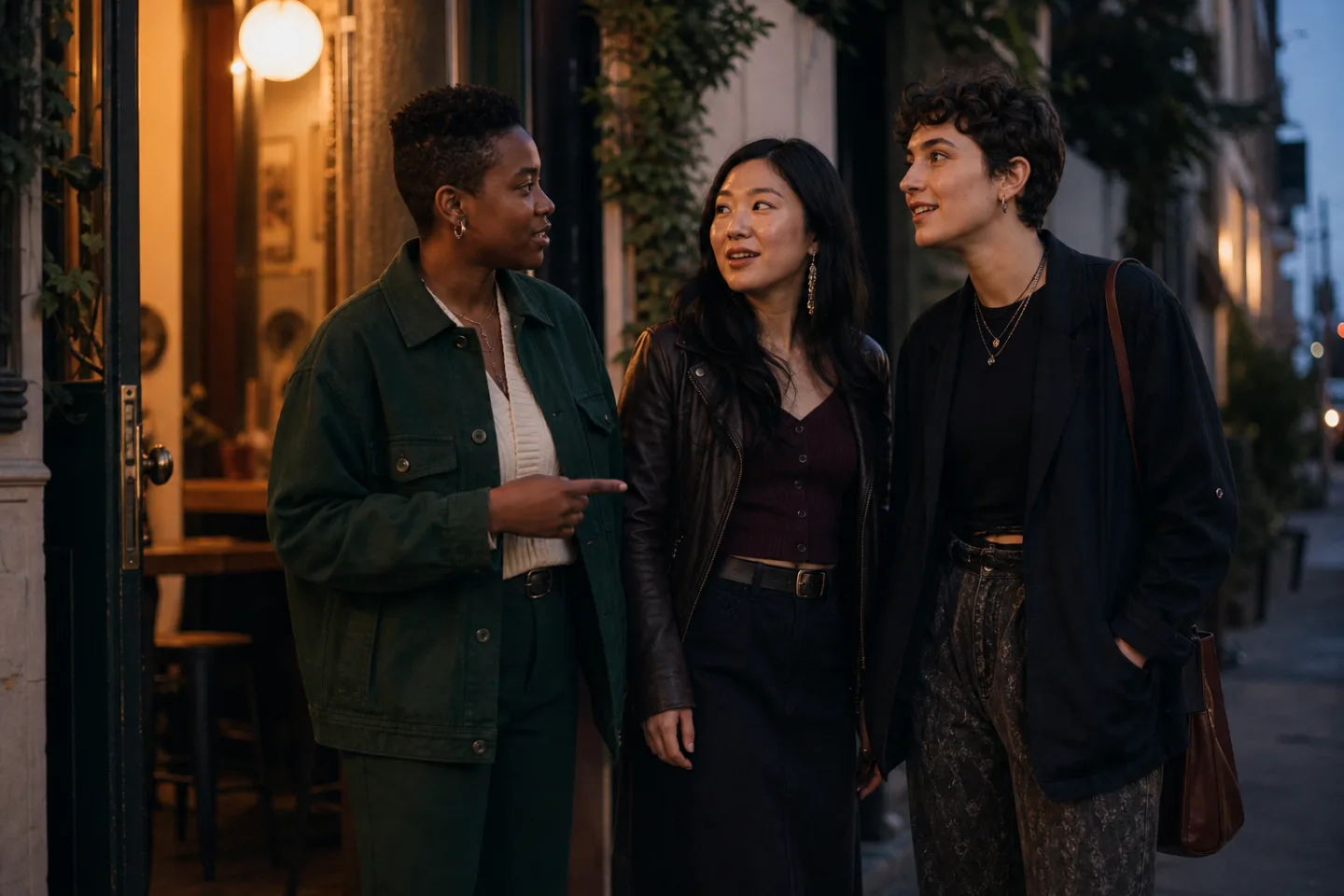
A useful late-night plan starts before entering: verify the event, choose the meeting point, and keep an independent way home.
Why bars and late nights can work — and when they do not
Our editorial view: a sapphic bar or clearly described sapphic night is useful when it removes one piece of uncertainty. You are not trying to infer from the room alone whether women who like women are an intended part of the audience. That does not make every interaction easy, but it gives the night a clearer starting point than a venue whose audience is left entirely implicit.
The late-night format can also give you a reason to be there besides introducing yourself. Music, a performance, a game, a dance floor, or simply ordering something at the bar gives your attention somewhere to go. This is our interpretation, not a measured promise of better outcomes: a setting with an activity may feel easier to enter because you have something to do before you speak to anyone.
It is a poor fit when the conditions work against what you need. Loud rooms can make conversation difficult. A late finish can make transport more complicated. A venue centered on drinking may be wrong for someone who avoids alcohol or does not want to explain that choice. Crowding, lighting, stairs, seating, cover charges, or unclear access information may matter more than the identity label on the event.
A practical rule we use: do not ask only, “Is this sapphic?” Ask, “Can I actually have the kind of night I want there?” Identity fit and practical fit are separate checks.
The supply is genuinely narrow, but the number needs a boundary
The best-known documentation project in this area, the Lesbian Bar Project, includes a section titled “THE 36 BARS” that lists 36 venues alphabetically (Lesbian Bar Project). The project describes its work as documenting lesbian and queer bars, but the page does not present that list as a census of every lesbian bar in the United States and does not state when the list was last comprehensively updated.
That distinction matters. “The project lists 36” is supported by the page. Treating that project list as the country's complete total would turn a documentary collection into an official national count, which the source does not claim.
Our inference from that limited evidence: a dedicated lesbian bar should be the first search, not the only search. If the closest result is far away or unclear, widen the venue type while keeping the audience requirement specific. A recurring sapphic night inside a broader venue, a queer event explicitly centered on women and sapphic people, or a late-opening community space may solve the actual problem even if the building is not labeled a lesbian bar.
How to find one in your city
Our editorial view: search in layers. Each layer answers a different question, and stopping after a map search leaves too much unverified.
Start narrow
Use combinations such as:
lesbian bar + city or regionsapphic night + city or regionqueer women event + city or regionwomen-centered queer space + city or region
The purpose is not to collect a long list. It is to find a small set of leads whose current information you can check.
Follow the organizer, not just the building
A recurring night may move between venues, while a venue may host very different audiences on different nights. We suggest looking for the organizer or host named on the current page, then reading how that organizer describes the audience. The reason is simple: the building category tells you where; the organizer's language tells you who the particular night is meant to center.
Verify the current plan
A practical rule we use: treat every directory result, old article, and shared graphic as a lead rather than proof. Before traveling, look for the same current plan in two places: preferably the venue or organizer's own page and a second current page tied to the same organizer or location. If the time, address, audience, or admission details conflict, mark the plan as unconfirmed instead of choosing the version you prefer.
The search is not complete when a promising name appears. Confirm the audience and current details, then make the outing easy to leave as well as easy to enter.
How to judge whether a place is worth the trip
No label proves that a venue will feel welcoming, accessible, or comfortable to you. The useful question is whether the available information lets you make a bounded, reversible plan.
We suggest checking five things:
- Audience clarity. Does the organizer plainly say who the space centers, or are you inferring it from imagery and hashtags?
- Currentness. Can you connect the plan to an active organizer or venue page, rather than an undated roundup?
- Room fit. Is the night built around dancing, watching, talking, or a scheduled activity? Choose the format, not just the label.
- Practical access. Can you verify the address, entry conditions, seating or access information you need, and a realistic route home?
- Exit flexibility. Can you leave without depending on a new acquaintance, a group decision, or a ride that has not been confirmed?
Our editorial view: audience clarity is the first filter, but exit flexibility is the final one. A promising event is not worth building a fragile plan around. If basic details remain contradictory or unavailable, choose a plan with fewer unknowns.
Make the outing easier
The goal is not to manufacture confidence before you go. It is to make the night small enough to try.
Pick a public place
Choose a meeting point that is public, specific, and easy to find without entering the busiest part of the room. We suggest deciding in advance what part of the night you are attending. “Arrive, get oriented, stay for the opening part, then decide” is a plan; “have a perfect night” is not.
Send a low-pressure invitation
Ask one person without implying that they are responsible for whether you go:
“I'm thinking about checking out a sapphic night. Want to meet there for the first part? No pressure if it isn't your thing.”
That wording is an example, not a script you have to copy. Our editorial reason for keeping it specific: a place and a bounded time are easier to answer than a vague request to “go out sometime.” The invitation should also leave room for either person to say no or leave separately.
Agree on meeting and leaving
Confirm the public meeting point, how you will recognize each other, and whether either person is relying on the other for transport. A practical rule we use: each person keeps an independent route home unless a different arrangement has been explicitly confirmed. “We can decide later” is not a transport plan.
First-time practicalities
If you arrive alone
Give yourself one immediate task: check the layout, locate staff, order what you want, or find the activity you came for. You do not have to scan the whole room for someone to talk to. If the room does not match the description or you feel more exposed than you expected, stepping outside or leaving is information, not failure.
How to open a conversation
Use the shared setting instead of demanding personal disclosure. Examples include:
- “Have you been to this kind of night before?”
- “Do you know what happens next?”
- “Is this seat taken?”
- “I'm deciding whether to stay for the next part — how are you finding it?”
We suggest asking something the other person can answer briefly. If the answer is short and no question comes back, let the conversation end without treating it as a problem to solve.
When you can leave
You can leave because the room is wrong, because the transport window is closing, because your energy changed, or simply because you want to. You do not owe a new person continued company. A short exit is enough: “I'm heading out — have a good night.” If you came with someone, tell them you are leaving; that is coordination, not a request for permission.
Alcohol and the ride home
Drinking is optional. If you do drink, decide the return plan before the night changes your decision-making. NIAAA states that how much and how quickly someone drinks affects impairment and acute risk, and advises avoiding alcohol when planning to drive or do something hazardous if alertness or coordination is impaired (NIAAA alcohol guidance). It also advises avoiding alcohol in several circumstances, including some medication interactions and health conditions; those are individual health questions, not something a venue guide can assess.
If someone is difficult to wake, is vomiting, has a seizure, or has trouble breathing, NIAAA lists those among the critical signs of alcohol overdose and says to call 911 without waiting for every sign to appear (NIAAA overdose guidance). Do not turn an emergency into a question about whether someone will be embarrassed.
What this guide can't tell you
This guide cannot tell you that a particular bar is open, that a recurring night still uses the same venue, or that a space will feel safe and welcoming to every sapphic woman. It does not rank venues or reproduce a directory.
MySapphic has not visited, tested, or interviewed the places a reader may find with this method. The site has no member reports and does not match people to attend together. It is a content guide, not a dating app.
The Lesbian Bar Project list is useful documentation, not a live national census. A venue's own description is useful evidence of intent, not proof of what every visit will be like. Our editorial boundary: when a detail affects whether you can enter, participate, or get home, verify it with the current venue or organizer before relying on it. When that verification is not possible, label the detail unknown and make a plan that does not depend on it.