WLW Meaning: What WLW Means—and How to Actually Meet People
WLW means “women loving women” or “women who love women.” It describes women who are romantically, emotionally, and/or sexually attracted to women, including many lesbian, bisexual, pansexual, and queer women. It is usually said letter by letter, “W-L-W,” although some people say “wuh-luh-wuh.”
That definition answers what does WLW mean. It does not tell you who is single, who wants a relationship, which non-binary people use the term, or where anyone actually meets. Those are the parts worth sorting out next.
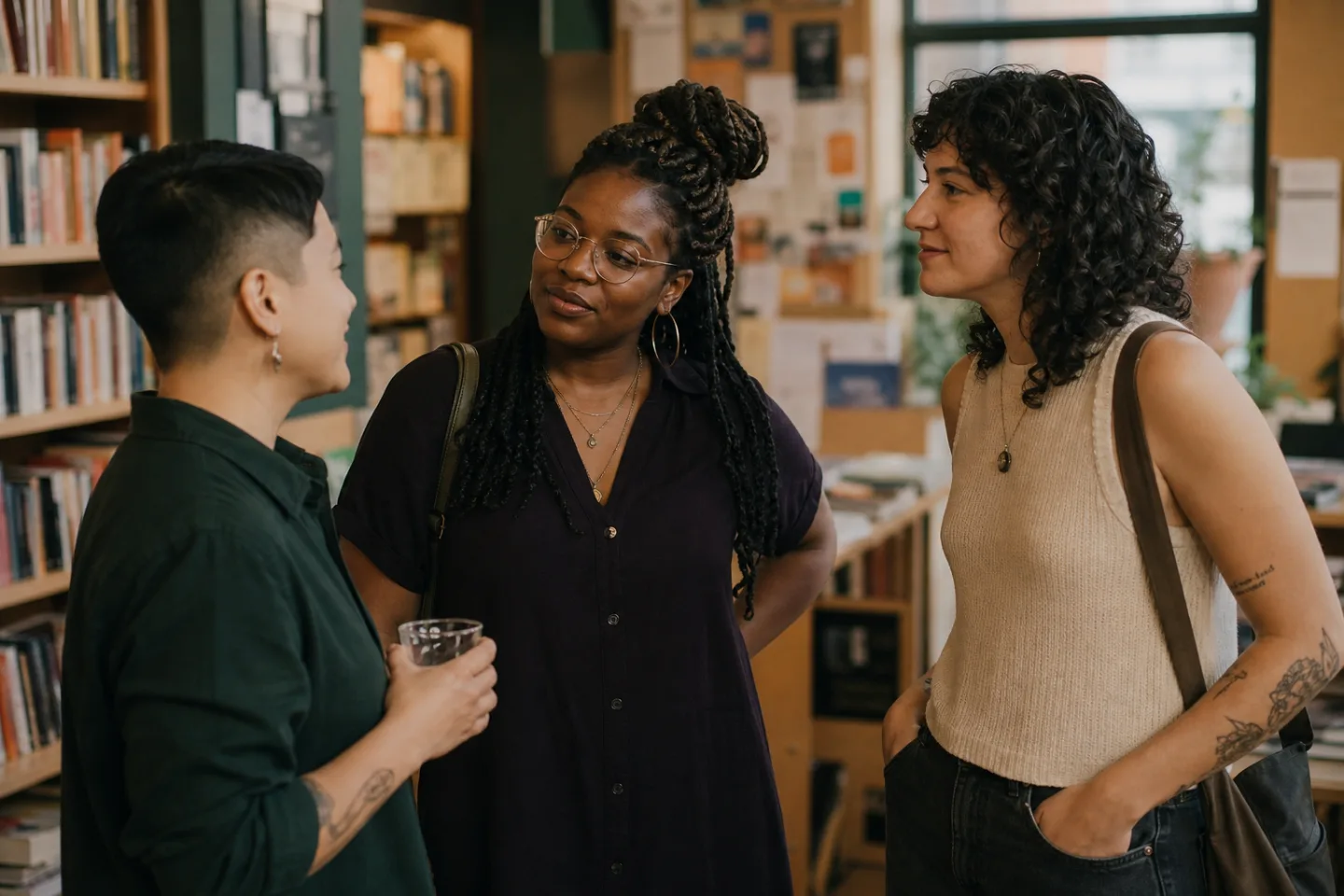
A shared label can help you find the room. A repeatable activity and a clear way to join are what make a first conversation possible.
What WLW includes, and what it does not tell you
WLW is useful because it gathers several orientations around one relevant fact: attraction to women. The PFLAG National Glossary includes lesbian, bisexual, pansexual, and otherwise same-gender-loving women in WLW. The LGBT National Help Center similarly describes it as women of any sexuality who are attracted to women in some way.
So a bisexual woman does not stop being WLW because she also dates men or people of other genders. A lesbian can be WLW, but “WLW” does not replace “lesbian” when lesbian is the identity she uses. A person also does not need a current girlfriend or any dating history to use an attraction label. PFLAG's lesbian and bisexual entries both separate orientation from having had a particular sexual experience.
The term can modify several different things:
- A person: “I’m WLW” communicates attraction to women without specifying a narrower orientation.
- A relationship: “a WLW couple” says the relationship involves women loving women; it does not tell you whether either person is lesbian, bi, pan, monogamous, or poly.
- A space: “a WLW book club” signals the intended community, but its own eligibility statement should still explain who may join.
- Media: “a WLW novel” or “WLW film” points to women-loving-women characters or relationships. Dictionary.com's usage summary documents this broader relationship and media use, while explicitly noting that its page is not a formal definition (Dictionary.com).
WLW does not mean any affection between women. Friends can love one another without being WLW. In LGBTQ+ usage, the phrase points to romantic, emotional, intimate, and/or sexual attraction, not ordinary friendship.
WLW vs. lesbian vs. sapphic vs. queer women
There is no central authority assigning these words. Institutional glossaries overlap, and they do not draw the non-binary boundary in exactly the same place. UC Davis even prefaces its glossary by saying its definitions are not universal and that individuals define their own identities (UC Davis LGBTQIA Resource Center). That is not a failure of the language. It is a reason to use each term for the job it actually does.
| Term | Most useful when | What not to assume |
|---|---|---|
| WLW | You need a compact umbrella for attraction, relationships, searches, tags, or a mixed-orientation group | That everyone is lesbian, available, or exclusively attracted to women |
| Lesbian | A person uses it as her or their orientation, or a space explicitly centers lesbians | That every woman attracted to women uses this identity |
| Sapphic | You want a closely related umbrella common in community, culture, and media contexts | That every person finds it clearer or more inclusive than WLW |
| Queer women | People or an organizer deliberately use “queer” for themselves | That all LGBTQ+ women reclaim or welcome the word “queer” |
Lesbian is the more specific identity word. PFLAG defines lesbian as a woman emotionally, romantically, and/or physically attracted to women, and it separately recognizes non-binary lesbian as an identity some non-binary people use (PFLAG glossary). The right practice is not to test whether someone satisfies your private definition; it is to use the identity they give you.
Sapphic substantially overlaps with WLW. PFLAG uses it for lesbian, bisexual, pansexual, and otherwise same-gender-loving women. The University of Wisconsin–Milwaukee includes some non-binary people who identify with womanhood in both “sapphic” and “WLW” (UWM LGBTQ+ Resource Center). UC Davis, however, notes that some people prefer “sapphic” because they consider it more inclusive of non-binary people. There is therefore no honest rule that makes one word universally broader.
Queer women is broader in a different direction. “Queer” can function as an umbrella or a personal identity, but it is also a reclaimed slur that not everyone uses. It is appropriate when people or a space use it for themselves; it is not a compulsory upgrade from lesbian, bisexual, or WLW.
Are non-binary people included in WLW?
Sometimes. That “sometimes” matters.
The UWM glossary includes non-binary people who identify with womanhood. UC Davis says some people move toward “sapphic” precisely because they find WLW's two Ws too narrow. Neither statement can decide how a particular non-binary person describes themselves.
A practical rule works better than an argument over the acronym:
- For a person, use their stated identity and pronouns.
- For an event, quote the organizer's audience language instead of silently widening or narrowing it.
- For yourself, use WLW if it communicates something useful; it does not require a committee's approval.
- If “woman” does not describe your relationship to gender, you do not need to accept WLW simply because someone else thinks it is inclusive.
The term's history has another uncertain edge. PFLAG says WLW is often used in communities of color, while the National LGBTQ Task Force describes women-loving-women as language coined by communities of color (Task Force glossary). The cited public sources do not establish one documented inventor and date, so this page does not claim one.
How WLW is used in actual searches, profiles, and spaces
WLW is strongest as a filtering word, not a complete introduction. A hashtag such
as #wlw, an event title, or a profile line can help the right audience recognize a
relevant space. It still leaves the practical questions unanswered.
“WLW looking to meet people” could mean dates, friends, collaborators, a first queer community, casual sex, or a long-term partner. Add the missing intention:
- “WLW, looking for a monogamous relationship and ready to meet locally.”
- “New to the area; looking for WLW friends and recurring community events.”
- “Sapphic book lover seeking a museum or coffee date.”
These are constructed examples, not quotations from real profiles. Their value is in making the next action visible. A label helps people find you; a specific invitation gives them something to answer.
When reading someone else's profile, do not turn “WLW” into information they did not provide. It does not confirm that they are lesbian, single, interested in you, or open to the same relationship structure. Read the rest of the profile, or ask a normal, bounded question.
After the definition: how to actually meet WLW
Choose one online route and one offline route. They solve different problems.
Online: pick for local fit, not a universal winner
HER offers a queer-women-centered pool; Lex leads with text and local posts; Feeld makes non-monogamy and relationship dynamics easier to state; Tinder and Hinge offer broader pools with more filtering. The source-linked trade-offs, paywalls, and privacy questions are compared in our guide to the best lesbian dating apps.
Use the free version first. Set a realistic distance, say what kind of connection you want, and look for evidence that suitable people are actually active near you. A brand's national user claim cannot answer that local question.
Offline: search for a repeatable structure
A one-night event creates one chance encounter. A recurring group creates the possibility of seeing the same people again. Start with our method for checking sapphic community spaces: confirm who the group centers, whether registration is required, and what a newcomer is expected to do.
If you prefer an activity to open mingling, try bookshops and cultural events. If nightlife is the point, verify the current event rather than assuming a venue always serves the same audience; the sapphic bars and late nights guide shows what to check. For a quieter first plan, use coffee and daytime spaces.
A concrete next step
In the next 15 minutes, choose one sentence that describes what you want: a date, new WLW friends, or a recurring local group. Put that sentence into one app profile or one search query with your city. Save one plausible option, check its current joining instructions, and choose when you will act on it.
Knowing what WLW means gets you through the first door. A named intention, a real place, and a time on the calendar are what turn the word into meeting someone.